
Vermont Coverage · Free Quote Comparison
Commercial Ice Machines in Vermont — Buy, Lease & Rent
Tell us what your Vermont operation needs — daily ice volume, industry, and where the machine will live. We’ll route your request to commercial ice machine suppliers covering your area so you can compare priced options side-by-side instead of chasing quotes one supplier at a time.
No obligation. No purchase required. Suppliers respond within 24 hours.
|
10+ Years Matching Buyers & Suppliers |
50 States Served Nationwide |
24 hrs Typical Supplier Response Time |
Free No Cost & No Obligation |
Ice Demand Across Vermont

Vermont’s commercial ice demand runs across three streams. Foodservice is the steady base: the U.S. Bureau of Labor Statistics counts about 1,470 food service and drinking establishments operating statewide in 2024, employing roughly 19,600 people, alongside about 420 accommodation businesses employing nearly 10,800 (per the U.S. Bureau of Labor Statistics, QCEW, 2024). That lodging headcount is unusually large for a state of about 648,000 residents, and it points straight at Vermont’s defining draw — a four-season tourism economy built on ski resorts, fall foliage, and the lodges, inns, and resort bars that serve them. Vermont drew roughly 15.8 million visitors who spent a record $4 billion in 2023 per the Vermont Agency of Commerce and Community Development. Health care adds a separate, year-round buying pattern, with the same federal source recording 51,343 health care and social assistance workers across the state, including 14,595 in hospitals and 6,706 in nursing and residential care. Underneath the tourism and healthcare layers sits an agricultural base unlike any other state’s: Vermont is the largest maple-syrup-producing state in the country, and its dairy farms and creameries anchor a working farm economy that feeds restaurants, agritourism, and food manufacturing alike.

Vermont’s climate makes ice machine specification refreshingly straightforward. Summers here are cool — NOAA NCEI 1991-2020 normals put July average highs at just 82°F in Burlington, 82°F in Montpelier, and 80°F in Rutland, well below the high-80s and 90s that hot-summer states contend with. That cool ambient air lets an air-cooled condenser reject heat easily and hold its rated output through the season, so there is no real summer derate to design around and air-cooled is the sensible default for the great majority of Vermont kitchens. A water-cooled or remote-condenser configuration is usually worth weighing only for a hot, unventilated back-of-house room or a very high-volume operation, where intake-air temperature climbs regardless of the weather outside. Vermont’s long, cold winters are not a problem for the equipment either, since commercial ice machines live indoors in conditioned space — the cold is a delivery-and-install scheduling consideration far more than an equipment one. For most operators the spec questions come down to the basics every buyer faces: daily ice volume, the ice type the operation needs, and the space available.
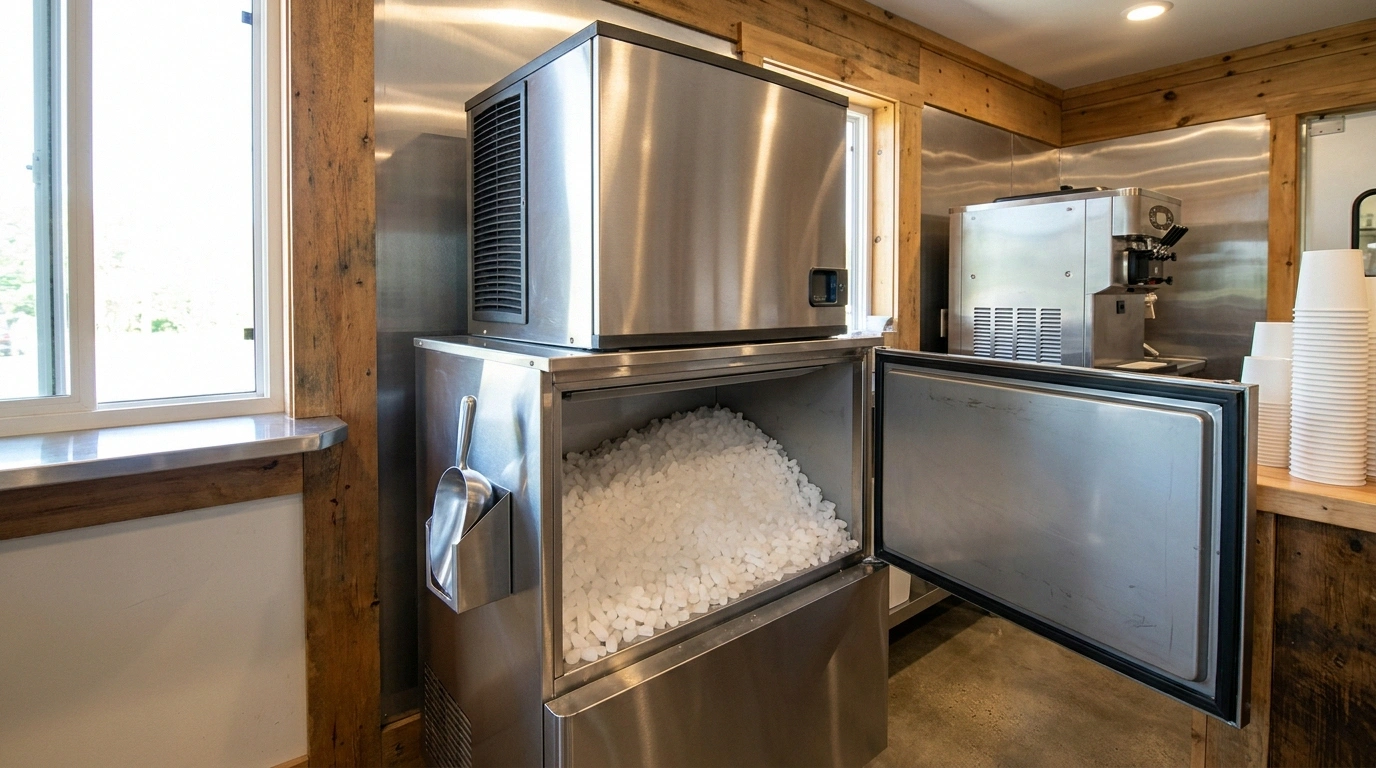
Seasonality matters here more than in most states, because demand arrives in waves rather than a steady line. Winter is a major pulse: Vermont’s alpine ski areas recorded about 4.1 million skier visits in the 2023-24 season — the top ski state in the East per the Vermont Ski Areas Association — concentrating hospitality demand in mountain resort towns like Killington and Stowe from December into March. Fall foliage drives a second sharp surge across the state in late September and October, filling inns, restaurants, and scenic-byway towns for a few intense weeks. Against those peaks runs a steadier base: the Burlington metro anchors year-round foodservice and healthcare demand independent of the tourist calendar, while the farm economy turns over all year — about 3.1 million gallons of maple syrup in 2024 and roughly 2.5 billion pounds of milk, both per the USDA National Agricultural Statistics Service, feeding sugarhouses, creameries, and agritourism. Mentioning your peak-week ice volume and operating window on the form helps suppliers spec equipment that holds up in season without sitting wildly oversized the rest of the year.
Start Your Free Vermont Quote Comparison
Takes about 60 seconds. Tell us what you need and we’ll handle the supplier outreach.
How the Quote Match Works in Vermont
|
1. Tell us what you need Daily ice requirement, your industry, buy/lease/rent preference, and where in Vermont the machine will live. About 60 seconds. |
2. Vermont suppliers compete Your request goes to commercial ice machine suppliers serving your area. They respond with priced options matched to your need — typically within 24 hours. |
3. You pick the best fit Compare prices, terms, warranty, and delivery side-by-side. Choose the supplier that fits — or walk away. The service is free either way. |
Equipment from leading manufacturers
Hoshizaki · Manitowoc · Scotsman · Ice-O-Matic · Follett · Maxx Ice
Vermont Metros We Cover
Major commercial ice machine demand in Vermont concentrates around Burlington and South Burlington, Rutland, the capital at Montpelier and neighboring Barre, and the southern towns of Brattleboro and Bennington, along with Essex in the Chittenden County metro — plus the mountain resort towns of Stowe and Killington, where ski-season and foliage hospitality demand spikes. Our supplier network covers buyers across these areas and the surrounding rural counties. Enter your ZIP code in the form above and we’ll route your request to suppliers actively serving that location.
Common Questions From Vermont Buyers
Do Vermont’s cool summers change which commercial ice machine I should choose?
They make the choice simpler than in hot-summer states. July average highs run only 82°F in Burlington, 82°F in Montpelier, and 80°F in Rutland per NOAA NCEI 1991-2020 normals, so the cool ambient air lets an air-cooled machine reject heat easily and run within spec for most of the year. That makes air-cooled the sensible default for the great majority of Vermont kitchens, and it means there is no real summer-heat derate to design around. Water-cooled or remote-condenser setups are usually only worth weighing for a hot, unventilated back-of-house room or a very high-volume site. Vermont’s cold winters are not a problem for the machine itself either, since these units live indoors in conditioned space. Tell suppliers where the machine will sit and roughly how much ice you need a day, and air-cooled will fit most Vermont operations.
Do suppliers cover Vermont’s ski-season and fall-foliage tourism towns when demand spikes?
Yes. The Vermont supplier network covers the mountain resort towns — Killington and Stowe among them — along with the Burlington metro and the rest of the state. Vermont’s alpine ski areas recorded about 4.1 million skier visits in the 2023-24 season, the top ski state in the East per the Vermont Ski Areas Association, and the state drew roughly 15.8 million visitors who spent a record $4 billion in 2023 per the Vermont Agency of Commerce and Community Development. That demand arrives in sharp pulses — the winter ski season and the fall foliage surge — so restaurants, lodges, inns, and resort bars in those corridors usually need capacity sized for their busiest week, not a quiet shoulder-season average. Mention your peak-week ice volume and operating window on the form so suppliers can spec the machine accordingly.
Can I get ice machine quotes for Vermont dairy, maple, agritourism, and lodge-bar applications?
Yes. Vermont is the largest maple-syrup-producing state in the country, making about 3.1 million gallons in 2024 — more than half the U.S. crop — and its dairy farms produced about 2.5 billion pounds of milk that year, both per the USDA National Agricultural Statistics Service. Sugarhouses, creameries, farm stands, and the agritourism operations built around them all draw ice demand, as do the lodge and resort bars and beverage programs across the state’s hospitality base of about 420 accommodation businesses employing nearly 10,800 people. Soft, chewable nugget ice is a common pick for those bars and beverage stations, as well as for Vermont’s large healthcare base. Note your application — farm operation, creamery, lodge bar, beverage service, or patient floor — and the ice type on the form so suppliers can match the right machine and production rate.
How quickly can suppliers deliver and install across Vermont, including the rural mountain towns?
Most Vermont buyers hear back within 24 hours regardless of location. Some suppliers operate from in-state hubs around Burlington, Rutland, and Montpelier; others serve Vermont from regional New England offices in New Hampshire, Massachusetts, or New York, which is normal for the smaller New England states and widens the pool competing for your order. Delivery and install windows into the mountain resort towns and the more rural counties depend on the supplier and the equipment, but the quote itself will land fast. Confirm lead time, install scheduling, and freight with each supplier before you commit.
Should you buy, lease, or rent a commercial ice machine?
It depends on how hard you run the machine and how you want to handle the cost. Buying tends to have the lowest long-run cost when a unit runs year-round and you can cover its own maintenance. Leasing spreads the cost into predictable monthly payments and often bundles service, repairs, and cleaning into the agreement — a common choice for restaurants and bars that want to preserve capital. Renting fits short-term, seasonal, or trial needs. Operating cost matters too: energy use, water use, and upkeep vary by machine type and by whether the unit is air-cooled or water-cooled. Tell us whether you want to buy, lease, or rent on the form and suppliers in Vermont will quote the options that fit, so you can compare side by side before deciding.
Is the quote service really free?
Yes. There is no charge to compare quotes through Ice Maker Depot. Suppliers pay us when they connect with new buyers — you never pay for the service or for the quotes themselves.
What if you are not sure what size machine you need?
Suppliers will help size the machine to your daily ice demand and the available space. If you are early in the process, our commercial ice maker buyer’s guide covers daily ice output by industry, undercounter vs modular tradeoffs, and water-cooled vs air-cooled selection — read it before you submit if you want a head start.
Ready to compare commercial ice machine quotes in Vermont?
Free service. No obligation. Typical response within 24 hours.